Understanding the Truth: Does a sphere have infinite surface area?
The concept of the sphere has long occupied a central position in both human aesthetics and scientific inquiry. From the celestial bodies that drift through the vacuum of space to the microscopic droplets of water clinging to a leaf, the sphere represents a pinnacle of geometric perfection. It is a shape defined by its symmetry, a form where every point on its surface is equidistant from its center. This inherent balance has made it a subject of fascination for philosophers, artists, and mathematicians for millennia.
However, within the rigorous confines of mathematical inquiry, certain intuitive perceptions often collide with formal proofs. One such point of contention arises when we contemplate the nature of boundaries and limits. When observing the complex textures of the natural world, one might begin to wonder about the scaling properties of shapes. This leads to a profound question that sits at the intersection of classical geometry and modern chaos theory: does a sphere have infinite surface area?
To answer this, one must move beyond mere visual observation and enter the realm of precise mathematical definitions. The distinction between a smooth, idealized manifold and a complex, fractal-like structure is not merely academic; it is the foundation upon which our understanding of physical reality is built. By examining the properties of the sphere through the lens of calculus and topology, we can resolve the confusion that often arises when comparing smooth geometric solids to the irregular geometries found in nature.
The Complete Overview of Does a sphere have infinite surface area
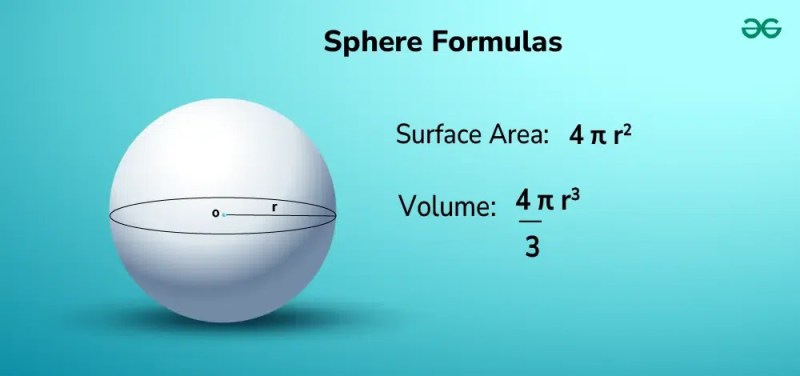
In the context of Euclidean geometry, the answer to whether a sphere has infinite surface area is a definitive no. A sphere is defined as a perfectly smooth, two-dimensional manifold embedded in three-dimensional space. Because it is smooth and lacks the recursive, self-similar complexities found in fractal geometry, its surface area is strictly bounded by its radius. The mathematical formula for the surface area of a sphere, $4\pi r^2$, demonstrates that as long as the radius is a finite number, the resulting area will also be a finite, calculable value.
The confusion regarding whether a sphere has infinite surface area often stems from a misunderstanding of how surface area is measured when dealing with irregular or "rough" objects. In the study of fractals, such as the Koch snowflake or various Menger sponges, increasing the resolution of a measurement reveals more detail, which in turn increases the measured surface area or perimeter, potentially leading to infinity. However, a mathematical sphere does not possess this recursive detail. No matter how much you zoom into the surface of an idealized sphere, it remains a smooth surface, and its area remains constant and finite.
Historical Background and Evolution
The study of spherical properties dates back to antiquity, with the Greeks making monumental strides in understanding the relationship between different geometric solids. Archimedes of Syracuse was perhaps the most significant figure in this evolution. In his treatise "On the Sphere and Cylinder," he utilized a method of exhaustion—a precursor to integral calculus—to prove that the surface area of a sphere is exactly four times the area of its greatest circle. This discovery was revolutionary, providing a geometric certainty that had previously been elusive.
Table of Contents
- The Complete Overview of Does a sphere have infinite surface area
- Historical Background and Evolution
- Core Mechanisms: How It Works
- Key Benefits and Crucial Impact
- Major Advantages
- Comparative Analysis
- Future Trends and Innovations
- Conclusion
- Comprehensive FAQs
- Q: Why do people often think a sphere has infinite surface area?
- Q: Is there any shape that has a finite volume but an infinite surface area?
- Q: How does the surface area of a sphere change if the radius doubles?
- Q: Does a sphere's surface area change depending on how closely you look at it?
- Q: What is the difference between a sphere and a hypersphere?
As mathematics progressed through the Renaissance and into the Enlightenment, the development of calculus provided a more robust framework for discussing limits and continuity. Mathematicians like Newton and Leibniz allowed for a formalization of how we calculate areas under curves and around volumes. This era moved geometry away from purely visual proofs toward analytical ones. It was during this period that the distinction between smooth curves and the more jagged, non-differentiable paths that would later define fractal geometry began to take shape, eventually allowing modern mathematicians to clarify exactly why a sphere's area remains finite while other shapes do not.
Core Mechanisms: How It Works
To understand why the surface area of a sphere is finite, one must examine the mechanics of its construction in a three-dimensional coordinate system. A sphere is the set of all points $(x, y, z)$ that satisfy the equation $x^2 + y^2 + z^2 = r^2$. This equation defines a surface that is "differentiable" at every point. In simpler terms, if you were to zoom in infinitely on any point on the sphere, the surface would increasingly resemble a flat plane. This property of local flatness is what prevents the surface area from escalating toward infinity as we increase our measurement precision.
The calculation of this area relies on the integration of infinitesimal elements. If we slice a sphere into an infinite number of thin circular rings, the sum of the areas of these rings converges to a specific, finite limit. This convergence is the mathematical heart of the matter. In fractal geometry, the "area" does not converge because the surface is constantly adding new, smaller structures as you increase the scale of observation. In a sphere, there are no such additional structures; the geometry is complete and closed, leading to a stable and predictable surface area.
Key Benefits and Crucial Impact
Understanding the distinction between finite and infinite surfaces is not merely a pursuit of theoretical purity. It has profound implications for how we model the physical universe. When engineers design pressure vessels, such as fuel tanks for spacecraft, they rely on the predictable, finite surface area of spherical shapes to calculate heat transfer, material stress, and fluid dynamics. If the surface area were subject to the unpredictable scaling of a fractal, the mathematics of engineering would become infinitely more complex and potentially impossible to solve with current methods.
Furthermore, this mathematical clarity allows cosmologists to model the shape and extent of the universe itself. Whether the universe is flat, open, or closed (spherical), the ability to calculate finite volumes and surface areas is essential for determining the density of matter and the rate of expansion. The stability of our physical laws depends on the fact that the fundamental shapes we interact with—from the atoms to the stars—obey the rules of finite geometry rather than the chaotic scaling of infinite fractals.
"Geometry is the foundation of all science, providing the language through which the structure of reality is articulated and understood."
Major Advantages
- Predictable Modeling: Allows for precise calculations in fluid dynamics, aerodynamics, and thermodynamics.
- Structural Integrity: Spherical shapes distribute stress evenly, a principle used in everything from submarine hulls to architectural domes.
- Computational Efficiency: In computer graphics and simulations, the finite and smooth nature of spheres allows for efficient rendering and collision detection.
- Cosmological Accuracy: Provides the necessary mathematical framework to study the curvature of spacetime and the geometry of the universe.
- Material Optimization: Enables manufacturers to calculate exactly how much material is needed to enclose a specific volume, minimizing waste.

Comparative Analysis
To further clarify the question of whether a sphere has infinite surface area, it is helpful to compare the sphere against other geometric and fractal entities. The following table highlights the fundamental differences in their surface properties.
| Geometric Feature | Euclidean Sphere | Fractal Surface (e.g., Koch Surface) | Cylinder | Cube |
|---|---|---|---|---|
| Surface Area Type | Finite and Constant | Potentially Infinite | Finite | Finite |
| Smoothness | Perfectly Smooth | Highly Irregular/Rough | Smooth (except edges) | Sharp Edges |
| Scaling Property | Area scales with $r^2$ | Area increases with resolution | Area scales with $r$ and $h$ | Area scales with $s^2$ |
| Mathematical Class | Smooth Manifold | Fractal Set | Smooth Manifold | Polyhedron |
Future Trends and Innovations
As we move deeper into the era of quantum mechanics and string theory, the question of whether a sphere has infinite surface area may take on a new, even more complex meaning. At the Planck scale—the smallest possible scale of measurement—the very notion of a "smooth" surface may break down. Some theories of quantum gravity suggest that spacetime itself may have a discrete or "foamy" structure. If spacetime is not a smooth continuum but is instead composed of tiny, fluctuating components, the classical definition of a sphere may need to be replaced by a more granular, perhaps even fractal, model.
In the realm of nanotechnology and material science, researchers are actively working to create "metamaterials" that mimic fractal geometries to maximize surface area within a finite volume. While these materials are not spheres in the classical sense, they represent a marriage of the two concepts: using the principles of infinite-like scaling to achieve massive surface areas for applications in catalysis, energy storage, and filtration. The tension between the smooth ideal of the sphere and the infinite complexity of the fractal continues to drive innovation at the frontiers of science.

Conclusion
In summary, the answer to the question "does a sphere have infinite surface area" is a clear and mathematically grounded no. Within the framework of Euclidean geometry, a sphere is a smooth, finite object with a surface area defined by the relationship $4\pi r^2$. The intuitive confusion regarding this topic usually arises from a conflation of smooth geometric shapes with fractal structures, which indeed exhibit the property of infinite surface area due to their recursive complexity.
Recognizing this distinction is vital for anyone studying mathematics, physics, or engineering. The sphere provides a stable, predictable model that allows us to understand the world around us, from the smallest particle to the largest galaxy. While the beauty of fractals offers a glimpse into the infinite complexity of nature, the elegance of the sphere provides the essential order and structure that makes the scientific study of our universe possible.
Comprehensive FAQs
Q: Why do people often think a sphere has infinite surface area?
A: This misconception usually stems from the "Coastline Paradox," where measuring an irregular or fractal shape results in a larger perimeter or surface area as the measurement scale becomes smaller. People mistakenly apply this logic to spheres, even though spheres are mathematically smooth and do not possess fractal complexity.
Q: Is there any shape that has a finite volume but an infinite surface area?
A: Yes, this is a well-known concept in mathematics. An example is "Gabriel's Horn" (or Torricelli's trumpet), a geometric figure that has a finite volume but an infinite surface area. This paradox is a classic study in calculus and limits.
Q: How does the surface area of a sphere change if the radius doubles?
A: Because the formula for surface area is $4\pi r^2$, the area is proportional to the square of the radius. Therefore, if you double the radius, the surface area increases by a factor of four ($2^2$).
Q: Does a sphere's surface area change depending on how closely you look at it?
A: In pure mathematics, no. A mathematical sphere is perfectly smooth at every scale. In the physical world, however, all objects have atomic structures, so at an extremely microscopic level, a "physical" sphere would appear irregular, but a "mathematical" sphere remains constant.
Q: What is the difference between a sphere and a hypersphere?
A: A sphere is a 2D surface in 3D space. A hypersphere (or n-sphere) is the generalization of a sphere to higher dimensions. For example, a 3-sphere is a 3D surface existing in 4D space, and it also has a finite "surface" volume.
Leave a Comment
Comments are moderated before appearing. The data you submit is processed according to the Privacy Policy of cixa.org.