Understanding Enzyme Kinetics: Does Competitive Inhibition Change Km?
Enzyme kinetics serves as the fundamental language of biological regulation. At the heart of this discipline lies the Michaelis-Menten model, a mathematical framework used to describe how the rate of an enzymatic reaction depends on the concentration of its substrate. For researchers in pharmacology, biochemistry, and metabolic engineering, understanding the nuances of how inhibitors interact with these biological catalysts is not merely an academic exercise; it is a necessity for drug design and metabolic control.
One of the most persistent questions encountered in laboratory settings and advanced examinations involves the specific mathematical shifts that occur when a molecule interferes with an enzyme's function. Specifically, students and professionals often ask: does competitive inhibition change Km? This question touches upon the very essence of affinity and substrate binding. To answer it, one must look beyond simple inhibition and examine the shifting equilibrium between the enzyme, the substrate, and the competing molecule.
To grasp the implications of this phenomenon, we must first establish a baseline of kinetic parameters. The Michaelis constant, or Km, represents the substrate concentration at which the reaction velocity reaches half of its maximum potential (Vmax). It is a measure of the enzyme's affinity for its substrate. When an inhibitor enters the fray, it can alter this perceived affinity, leading to profound changes in how we interpret the efficiency of a biological system. This article provides a rigorous examination of these kinetic shifts.

The Complete Overview of Enzyme Inhibition Dynamics
Enzyme inhibition is a process where a molecule, known as an inhibitor, binds to an enzyme and decreases its activity. This is a cornerstone of both natural metabolic regulation and the mechanism of action for most pharmaceutical drugs. In a biological context, inhibition allows a cell to throttle specific pathways to prevent the overproduction of metabolites or to respond to environmental stressors. In a clinical context, many drugs are designed specifically to act as inhibitors, targeting enzymes that are overactive in disease states.
When discussing the specific mechanics of how an inhibitor affects kinetic constants, we must categorize the inhibition by its binding site. Competitive inhibition is perhaps the most intuitive form. In this scenario, the inhibitor structurally resembles the substrate and competes for the same active site on the enzyme. Because the inhibitor and the substrate are vying for the same physical space, the presence of the inhibitor dictates the observed rate of reaction. This leads directly to the central inquiry: does competitive inhibition change Km, and if so, by what magnitude?
Historical Background and Evolution
The mathematical foundation of enzyme kinetics was laid in the early 20th century, primarily through the pioneering work of Leonor Michaelis and Maud Menten. Their development of the Michaelis-Menten equation provided a way to quantify the relationship between substrate concentration and reaction rate. Before their work, the understanding of enzyme behavior was largely qualitative. Their ability to introduce the concept of the Michaelis constant (Km) allowed scientists to begin comparing the efficiency of different enzymes and understanding their physiological roles.
Table of Contents
- The Complete Overview of Enzyme Inhibition Dynamics
- Historical Background and Evolution
- Core Mechanisms: How It Works
- Key Benefits and Crucial Impact
- Major Advantages of Understanding Competitive Inhibition
- Comparative Analysis
- Future Trends and Innovations
- Conclusion
- Comprehensive FAQs
- Q: Why does Vmax remain unchanged in competitive inhibition?
- Q: If Km increases, does that mean the enzyme's affinity has decreased?
- Q: How can I distinguish competitive inhibition from non-competitive inhibition on a Lineweaver-Burk plot?
- Q: Can a competitive inhibitor ever decrease the Vmax?
- Q: What is the relationship between the inhibitor constant (Ki) and the change in Km?
As the field of pharmacology expanded in the mid-20th century, the study of inhibition became more sophisticated. Scientists began to distinguish between different modes of inhibition—competitive, non-competitive, and uncompetitive—based on how they altered the Vmax and Km values. This era saw the development of the Lineweaver-Burk plot, a double-reciprocal transformation of the Michaelis-Menten equation that made it visually and mathematically easier to identify the type of inhibition occurring in a reaction. This historical progression turned enzyme kinetics from a descriptive science into a predictive one.
Core Mechanisms: How It Works
In competitive inhibition, the inhibitor (I) binds reversibly to the free enzyme (E) at the active site, forming an enzyme-inhibitor (EI) complex. This complex is catalytically inactive, meaning it cannot convert the substrate into product. The crucial aspect of this mechanism is that the binding of the inhibitor is mutually exclusive with the binding of the substrate (S). If the inhibitor occupies the active site, the substrate cannot enter, and vice versa. This creates a direct competition that is governed by the relative concentrations of the substrate and the inhibitor, as well as their respective affinities for the enzyme.
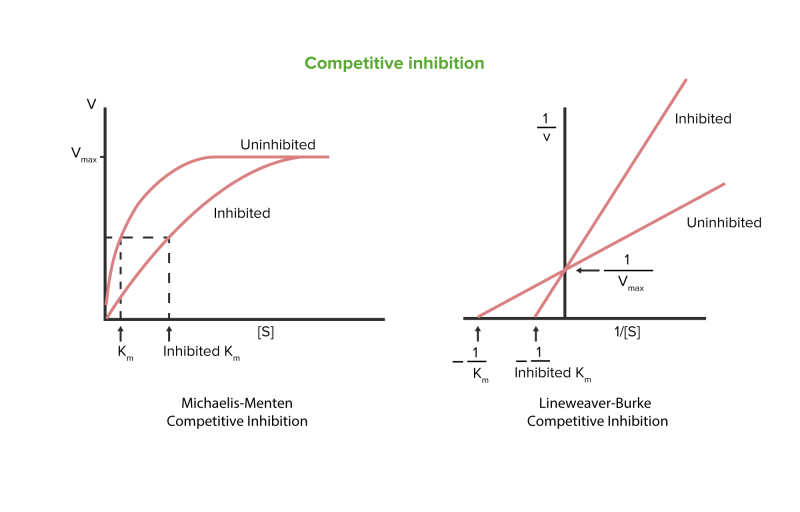
The kinetic consequence of this competition is that the enzyme appears to have a lower affinity for its substrate. To achieve the same reaction velocity that would be seen in the absence of an inhibitor, one must increase the substrate concentration to "outcompete" the inhibitor molecules. Because Km is defined as the substrate concentration required to reach half-Vmax, and because more substrate is now required to overcome the presence of the inhibitor, the apparent Km increases. However, if the substrate concentration is sufficiently high, it will eventually displace the inhibitor entirely, allowing the enzyme to reach its original maximum velocity (Vmax). Therefore, the fundamental answer to whether competitive inhibition changes Km is a definitive yes: the apparent Km increases, while Vmax remains unchanged.
Key Benefits and Crucial Impact
Understanding the nuances of competitive inhibition is not just a theoretical pursuit; it has massive practical implications in medicine and biotechnology. By manipulating the Km and Vmax of specific enzymes, scientists can design drugs that effectively "shut down" harmful pathways without permanently altering the enzyme structure. This reversibility is a key safety feature in many therapeutic interventions, allowing for fine-tuned control over metabolic processes.
Furthermore, the ability to predict how an inhibitor will behave using kinetic constants allows for the optimization of industrial processes. In the production of biofuels or pharmaceuticals, enzymes are often used as catalysts. Knowing how impurities or byproduct molecules might act as competitive inhibitors allows engineers to design reaction environments that maximize yield and efficiency by maintaining optimal substrate-to-inhibitor ratios.
"The precision of enzyme kinetics allows us to treat the human body not as a black box, but as a sophisticated chemical reactor where every reaction can be modulated through targeted molecular intervention."
Major Advantages of Understanding Competitive Inhibition
- Targeted Drug Design: Enables the creation of competitive inhibitors that mimic natural substrates to block specific disease-causing enzymes.
- Metabolic Regulation: Provides insight into how cells use feedback inhibition to maintain homeostasis by regulating enzyme activity.
- Predictable Pharmacokinetics: Allows researchers to calculate how much of a drug is needed to achieve a therapeutic effect based on substrate competition.
- Industrial Optimization: Helps in minimizing the impact of competitive inhibitors in large-scale enzymatic industrial fermentations.
- Diagnostic Utility: Facilitates the development of assays that use competitive binding to measure the concentration of specific analytes in clinical samples.

Comparative Analysis
To clearly understand how competitive inhibition differs from other types, it is helpful to compare its effect on the primary kinetic parameters: Km and Vmax. The following table summarizes these distinctions.
| Inhibition Type | Effect on Km (Apparent) | Effect on Vmax | Binding Site |
|---|---|---|---|
| Competitive | Increases | Unchanged | Active Site |
| Non-competitive | Unchanged | Decreases | Allosteric Site |
| Uncompetitive | Decreases | Decreases | Enzyme-Substrate Complex |
| Mixed | Increases or Decreases | Decreases | Both Sites |
Future Trends and Innovations
The future of enzyme kinetics lies in the integration of computational modeling and high-throughput screening. As we move toward an era of personalized medicine, the ability to simulate how a specific individual's enzyme variants will react to a competitive inhibitor is becoming a reality. Machine learning algorithms are now being trained to predict the binding affinity of potential inhibitors, significantly accelerating the drug discovery process and reducing the reliance on trial-and-error laboratory work.
Additionally, advancements in single-molecule spectroscopy are allowing researchers to observe enzyme-inhibitor interactions in real-time at the level of individual molecules. This level of detail will provide unprecedented insights into the transient states of competitive inhibition, potentially revealing new ways to modulate enzyme activity that go beyond simple active-site competition. We are moving from a macroscopic understanding of kinetics to a microscopic, dynamic view of molecular choreography.
Conclusion
In summary, the question of whether competitive inhibition changes Km is central to the study of biochemistry. Through rigorous kinetic analysis, we have established that competitive inhibitors increase the apparent Km of an enzyme by competing for the active site, while leaving the maximum velocity (Vmax) unaffected. This distinction is vital for identifying the mode of inhibition and for the practical application of these principles in medicine and industry.
As our understanding of these molecular interactions deepens, the ability to manipulate enzyme activity becomes more precise. Whether through the design of life-saving drugs or the optimization of industrial biocatalysts, the principles of competitive inhibition remain a cornerstone of modern scientific progress. Mastering these concepts is essential for anyone navigating the complex landscape of biological chemistry.
Comprehensive FAQs
Q: Why does Vmax remain unchanged in competitive inhibition?
A: Vmax remains unchanged because competitive inhibition is reversible and depends on the concentration of the substrate. If you increase the substrate concentration to a sufficiently high level, the substrate molecules will effectively "outcompete" the inhibitor for the active sites. Eventually, the probability of an inhibitor molecule hitting the active site becomes negligible compared to the substrate, allowing the enzyme to reach its maximum theoretical reaction rate.
Q: If Km increases, does that mean the enzyme's affinity has decreased?
A: Yes, in an "apparent" sense. Km is inversely related to affinity. A higher Km value indicates that a higher concentration of substrate is required to occupy half of the enzyme's active sites. In the presence of a competitive inhibitor, the enzyme's ability to bind the substrate is hindered, which is mathematically reflected as an increase in the Km value, signifying a decrease in perceived affinity.
Q: How can I distinguish competitive inhibition from non-competitive inhibition on a Lineweaver-Burk plot?
A: On a Lineweaver-Burk plot (a double-reciprocal plot), competitive inhibition is characterized by lines that intersect at the y-axis. This is because the y-intercept represents 1/Vmax, and since Vmax does not change, the intercept remains constant. In contrast, non-competitive inhibition shows lines that intersect at the x-axis, because the x-intercept represents -1/Km, which remains unchanged in non-competitive inhibition, while the y-intercept changes due to the decrease in Vmax.
Q: Can a competitive inhibitor ever decrease the Vmax?
A: By definition, a pure competitive inhibitor does not change the Vmax. If an inhibitor is observed to decrease the Vmax, it is likely acting through a different mechanism, such as non-competitive or mixed inhibition, where the inhibitor binds to a site other than the active site or binds to the enzyme-substrate complex, thereby reducing the overall catalytic capacity of the enzyme regardless of substrate concentration.
Q: What is the relationship between the inhibitor constant (Ki) and the change in Km?
A: The increase in the apparent Km (Km_app) in the presence of a competitive inhibitor is directly related to the inhibitor constant (Ki), which measures the dissociation constant of the enzyme-inhibitor complex. The relationship is expressed as Km_app = Km (1 + [I]/Ki), where [I] is the concentration of the inhibitor. This formula shows that as the concentration of the inhibitor increases, or as the Ki decreases (meaning a stronger inhibitor), the apparent Km increases proportionally.
Leave a Comment
Comments are moderated before appearing. The data you submit is processed according to the Privacy Policy of cixa.org.