Solving the Math: What Integer is Closest to 31 7
Mathematical inquiry often begins with a seemingly simple question that serves as a gateway to understanding the foundational principles of number theory. When an individual asks, what integer is closest to 31 7, they are not merely seeking a single digit; they are engaging with the concept of approximation, the mechanics of division, and the spatial logic of the number line. This specific inquiry requires a transition from raw data—two distinct numbers—into a singular, cohesive mathematical operation.
To address the query of what integer is closest to 31 7, one must first interpret the relationship between the two figures. In standard mathematical notation, this expression typically implies a division operation, specifically 31 divided by 7. This process yields a quotient that is not a whole number, creating a decimal remainder that necessitates the application of rounding rules. The journey from a fraction to its nearest integer is a fundamental skill used in everything from engineering to financial forecasting.
Understanding the proximity of a value to its nearest whole number involves more than just mental arithmetic. It requires an appreciation for the concept of "distance" on a number line. By determining whether a value sits closer to the floor or the ceiling of its current position, we arrive at a definitive answer. This article provides an exhaustive examination of this specific calculation, the logic behind rounding, and the broader implications of integer approximation in professional and academic settings.

The Complete Overview of what integer is closest to 31 7
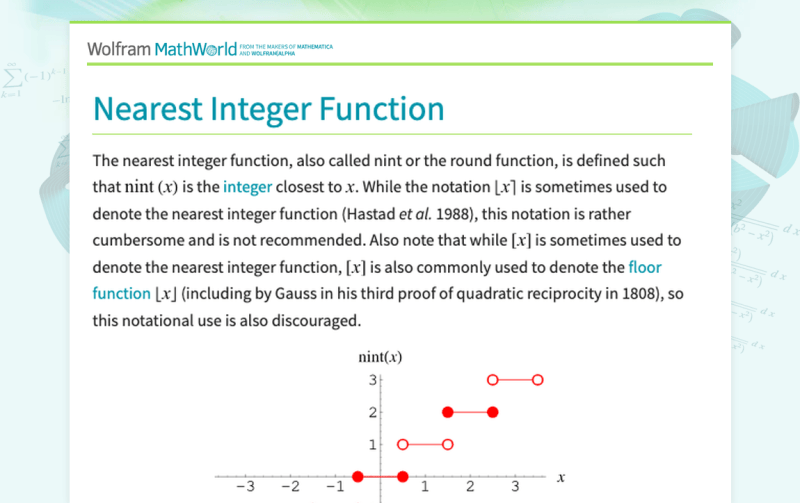
At its most basic level, the question of what integer is closest to 31 7 is a request for the result of 31 divided by 7, rounded to the nearest whole number. When we perform the division, 31 divided by 7 equals approximately 4.42857. Because the decimal portion, .42857, is less than the halfway threshold of .5, the value is pulled downward toward the nearest whole integer. Therefore, the answer to what integer is closest to 31 7 is 4.
This process highlights the distinction between exact values and approximations. In pure mathematics, 31/7 is a rational number that can be expressed as a repeating decimal. However, in practical applications—such as calculating the number of containers needed for a volume of liquid or estimating the number of people in a group—we require integers. The ability to identify which integer is closest to 31 7 allows for more efficient decision-making when perfect precision is either impossible or unnecessary.
Historical Background and Evolution
The concept of rounding and integer approximation has been a cornerstone of human civilization since the earliest days of commerce. Ancient Mesopotamian and Egyptian mathematicians utilized various forms of approximation to manage grain distributions, land measurements, and astronomical observations. They understood that while nature and commerce often deal in messy, fractional realities, human systems—such as counting coins or livestock—require the stability of integers.
Table of Contents
- The Complete Overview of what integer is closest to 31 7
- Historical Background and Evolution
- Core Mechanisms: How It Works
- Key Benefits and Crucial Impact
- Major Advantages
- Comparative Analysis
- Future Trends and Innovations
- Conclusion
- Comprehensive FAQs
- Q: Why is the answer 4 and not 5?
- Q: How do I calculate 31 divided by 7 manually?
- Q: What is the difference between rounding and truncating?
- Q: Is 31/7 a rational or irrational number?
- Q: What is the "ceiling" of 31/7?
As mathematics evolved through the Greek era and into the Islamic Golden Age, the formalization of division and the study of rational numbers became more sophisticated. The development of the decimal system provided a standardized way to express the "distance" between an integer and its fractional counterpart. This evolution turned the question of what integer is closest to 31 7 from a matter of guesswork into a rigorous logical procedure based on the properties of the number line.
Core Mechanisms: How It Works
The mechanics of finding the nearest integer rely on the division algorithm. First, we establish the quotient by dividing the dividend (31) by the divisor (7). This gives us a decimal value. The second step involves analyzing the first digit after the decimal point. In the case of 31 divided by 7, the result is 4.428... The digit in the tenths place is 4. According to standard rounding rules, if the tenths digit is 4 or less, we round down to the current integer; if it is 5 or greater, we round up to the next integer.
Another way to visualize this is through the concept of absolute difference. To find what integer is closest to 31 7, we compare the distance between 4.428 and 4, and the distance between 4.428 and 5. The distance to 4 is |4.428 - 4| = 0.428. The distance to 5 is |5 - 4.428| = 0.572. Since 0.428 is a smaller distance than 0.572, the integer 4 is mathematically the closest.
Key Benefits and Crucial Impact
Mastering the ability to quickly determine what integer is closest to a specific division result has profound implications across various disciplines. In the realm of data science, rounding allows for the simplification of complex models without losing significant accuracy. In construction, estimating materials often requires rounding up or down to ensure structural integrity or cost-effectiveness. Even in everyday life, such as estimating time or budget, this logic is constantly at play.
Furthermore, understanding the nuances of approximation prevents common errors in logic. If one were to mistakenly round 4.428 up to 5, the resulting error could compound in larger datasets, leading to significant discrepancies. Recognizing the precise answer to what integer is closest to 31 7 reinforces the discipline of mathematical accuracy and the importance of following established protocols for estimation.
"Mathematics is not about numbers, equations, computations, or algorithms: it is about understanding." — William Paul Thurston
Major Advantages
- Efficiency in Estimation: Rapidly identifying the nearest integer allows for quick mental calculations in high-pressure environments.
- Data Simplification: Reducing complex decimals to integers makes information more digestible for non-technical audiences.
- Error Reduction: Applying consistent rounding rules minimizes the cumulative error in multi-step mathematical operations.
- Resource Management: Helps in determining the necessary quantity of discrete items (like vehicles or tools) needed for a task.
- Cognitive Development: Practicing these calculations strengthens the logical reasoning skills required for advanced STEM fields.

Comparative Analysis
| Methodology | Approach to 31/7 | Resulting Integer | Primary Use Case |
|---|---|---|---|
| Standard Rounding | Look at the .4 decimal | 4 | General mathematics and statistics |
| Floor Function | Always round down | 4 | Computer programming and discrete math |
| Ceiling Function | Always round up | 5 | Logistics and capacity planning |
| Truncation | Remove the decimal | 4 | Financial data processing |
Future Trends and Innovations
As we move further into the era of Artificial Intelligence and automated computation, the way we approach simple questions like what integer is closest to 31 7 is changing. While humans will always need to understand the underlying logic, machines are now capable of performing these calculations at a scale and speed that was previously unimaginable. We are seeing a shift from manual calculation to the management of algorithmic precision, where the focus is on how rounding affects large-scale machine learning models.
In the future, "fuzzy logic" and probabilistic rounding may become more prevalent in computational mathematics. Instead of a hard jump from 4.4 to 4, systems might maintain a degree of uncertainty to better reflect real-world variability. However, the fundamental principle—finding the most representative integer for a given value—will remain a vital component of both human thought and machine intelligence.
Conclusion
In summary, determining what integer is closest to 31 7 is a straightforward yet illuminating mathematical exercise. By dividing 31 by 7 to get approximately 4.428 and applying the standard rules of rounding, we find that 4 is the most accurate whole-number representation. This process touches upon the very essence of how we translate continuous, fractional reality into the discrete, manageable units of the integer system.
Whether you are a student tackling a homework problem or a professional refining a statistical model, the ability to navigate these approximations is essential. The logic used to solve what integer is closest to 31 7 is the same logic that underpins much of our modern technological and economic infrastructure. Precision in thought leads to precision in practice, ensuring that our estimations are as close to the truth as possible.
Comprehensive FAQs
Q: Why is the answer 4 and not 5?
A: The answer is 4 because when you divide 31 by 7, the result is approximately 4.428. In rounding, if the decimal part is less than 0.5, you round down to the nearest integer. Since 0.428 is less than 0.5, 4 is the closest integer.
Q: How do I calculate 31 divided by 7 manually?
A: You can use long division. 7 goes into 31 four times (7 x 4 = 28). Subtract 28 from 31 to get a remainder of 3. To continue into decimals, add a decimal point and a zero to make it 30. 7 goes into 30 four times (7 x 4 = 28), leaving a remainder of 2, and so on.
Q: What is the difference between rounding and truncating?
A: Rounding looks at the value of the decimal to decide whether to go up or down (4.4 becomes 4, but 4.6 becomes 5). Truncating simply cuts off the decimal entirely without looking at its value (both 4.4 and 4.6 would become 4).
Q: Is 31/7 a rational or irrational number?
A: It is a rational number because it can be expressed as a fraction of two integers (31/7). Rational numbers either terminate or repeat in their decimal form, and 31/7 results in a repeating decimal.
Q: What is the "ceiling" of 31/7?
A: The ceiling function always rounds up to the nearest integer regardless of the decimal value. Therefore, the ceiling of 31/7 is 5.
Leave a Comment
Comments are moderated before appearing. The data you submit is processed according to the Privacy Policy of cixa.org.