Calculus Essentials: When Do You Use the Chain Rule?

The Architecture of Composition
Calculus serves as the mathematical language of change, providing the tools necessary to quantify how one variable responds to another. Within this discipline, the derivative stands as a cornerstone, representing the instantaneous rate of change. However, real-world systems rarely operate through simple, isolated variables. Instead, they function through layers of dependency, where one change triggers a secondary reaction, which in turn influences a third. This layering of mathematical relationships creates composite functions, necessitating a specific procedural approach to differentiation.
The fundamental question for students and engineers alike is: when do you use the chain rule? The answer lies in the structure of the function being analyzed. When a function is not a simple sum or product of independent terms, but rather a function nested within another, the standard power, product, or quotient rules are insufficient on their own. Recognizing these nested structures is the first step toward navigating complex mathematical landscapes, from physics to machine learning algorithms.
To master this concept, one must move beyond rote memorization of formulas and develop a keen eye for functional hierarchy. Understanding the distinction between an "inner" function and an "outer" function is the difference between a correct derivation and a fundamental error. This article examines the precise conditions, the historical context, and the practical applications of this indispensable tool, ensuring you know exactly when to deploy it in your analytical work.
The Complete Overview of the Chain Rule
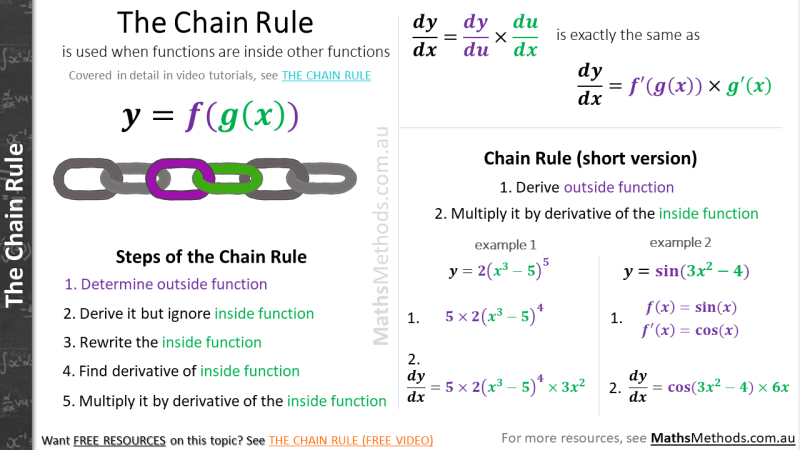
At its essence, the chain rule is a formula used to compute the derivative of a composite function. A composite function is formed when the output of one function becomes the input of another. Mathematically, if we have a function $y = f(g(x))$, the chain rule dictates that the derivative $dy/dx$ is the product of the derivative of the outer function $f$ evaluated at the inner function $g$, and the derivative of the inner function $g$. This process effectively "unwraps" the layers of the function to find the total rate of change.
Determining when do you use the chain rule requires identifying these layers. If you encounter a term like $\sin(x^2)$, you are not merely looking at a sine function; you are looking at a sine function whose argument is itself a function. The "outer" part is the sine, and the "inner" part is the $x^2$. Without the chain rule, you would only be accounting for the rate of change of the sine wave, ignoring the accelerating rate of change provided by the squared term. The chain rule bridges this gap by multiplying these two rates together.
Historical Background and Evolution
The development of the chain rule was not a singular event but an evolution of thought during the 17th-century scientific revolution. While the foundations of calculus were laid by Isaac Newton and Gottfried Wilhelm Leibniz, the formalization of the rules for differentiating composite functions required a deeper understanding of limits and infinitesimal changes. Leibniz, in particular, contributed to the notation that makes the chain rule intuitive today, using the $dy/dx$ notation which visually represents the "chaining" of ratios.
As mathematics progressed into the 19th and 20th centuries, the rigors of epsilon-delta proofs provided the logical scaffolding necessary to justify the chain rule's validity. What began as an observation of motion and fluxions evolved into a rigorous theorem of real analysis. Today, the rule is not just a tool for manual calculation but a fundamental component in the algorithmic differentiation used by modern computers to optimize complex neural networks.
Table of Contents
- The Architecture of Composition
- The Complete Overview of the Chain Rule
- Historical Background and Evolution
- Core Mechanisms: How It Works
- Key Benefits and Crucial Impact
- Major Advantages
- Comparative Analysis
- Future Trends and Innovations
- Conclusion
- Comprehensive FAQs
- Q: How can I tell if a function requires the chain rule?
- Q: Can I use the chain rule and the product rule at the same time?
- Q: What is the most common mistake when applying the chain rule?
- Q: Is there a difference between the chain rule and the power rule?
- Q: Does the chain rule work for multivariable functions?
Core Mechanisms: How It Works
The mechanism of the chain rule relies on the principle of proportionality. Imagine three variables, $u$, $v$, and $x$, where $v$ depends on $u$, and $u$ depends on $x$. If $v$ changes twice as fast as $u$, and $u$ changes three times as fast as $x$, then $v$ must change $2 \times 3 = 6$ times as fast as $x$. This multiplicative relationship is the heartbeat of the rule. In calculus terms, $\frac{dv}{dx} = \frac{dv}{du} \cdot \frac{du}{dx}$.
When applying this to a function, the process is often described as "differentiation from the outside in." You first differentiate the outermost operation while keeping the inner expression intact, then you multiply that result by the derivative of the expression that was inside. This step-by-step decomposition allows even the most intimidating expressions—such as $\ln(\cos(e^{x^2}))$—to be broken down into manageable, sequential derivatives.
Key Benefits and Crucial Impact
The ability to differentiate composite functions is not merely an academic exercise; it is a requirement for modeling the complexity of the natural world. Most physical phenomena are interconnected. For instance, the pressure of a gas depends on its temperature, which in turn depends on the energy being added to the system. To understand how pressure changes with energy, one must use the chain rule to link these intermediate dependencies.
Furthermore, in the realm of modern technology, the chain rule is the engine behind backpropagation in artificial intelligence. Deep learning models consist of millions of nested functions (layers). To train these models, we must calculate how much each individual weight contributes to the final error. This is achieved by applying the chain rule repeatedly across the layers of the network, allowing the system to "learn" through gradient descent.
"Mathematics is not about numbers, equations, computations, or algorithms: it is about understanding." — William Paul Thurston
Major Advantages
- Simplification of Complexity: It allows for the decomposition of highly intricate functions into a series of elementary derivatives.
- Versatility in Modeling: It enables the mathematical description of multi-stage processes where one variable influences another through an intermediary.
- Efficiency in Computation: It provides a systematic algorithmic approach that can be implemented in software for automated differentiation.
- Foundation for Higher Calculus: Mastery of this rule is a prerequisite for understanding partial derivatives and the multivariable chain rule.
- Error Reduction: By providing a structured "outside-in" method, it reduces the likelihood of overlooking components of a complex derivative.
Comparative Analysis
To better understand when do you use the chain rule, it is helpful to compare it against other fundamental rules of differentiation. Choosing the wrong rule is a common pitfall for students.
| Rule Type | Primary Use Case | Relationship Between Terms |
|---|---|---|
| Power Rule | Single variable terms with exponents | Independent variable raised to a constant |
| Product Rule | Two functions multiplied together | $f(x) \cdot g(x)$ |
| Quotient Rule | Two functions divided by each other | $f(x) / g(x)$ |
| Chain Rule | Nested or composite functions | $f(g(x))$ |

Future Trends and Innovations
As we move further into the era of computational science, the application of the chain rule is shifting from manual calculation to automated symbolic manipulation. The rise of "Automatic Differentiation" (AD) in software frameworks like PyTorch and TensorFlow is a direct evolution of the chain rule. These systems do not just approximate derivatives; they use the chain rule to compute exact derivatives of complex code, enabling the training of models with trillions of parameters.
Looking ahead, we can expect the chain rule to play an even more significant role in quantum computing and complex systems modeling. As we attempt to simulate quantum states and biological networks, the layers of dependency will become increasingly non-linear and multi-dimensional. The mathematical principles governing these systems will rely on generalized versions of the chain rule to navigate the high-dimensional manifolds of data and physical reality.
Conclusion
Understanding when do you use the chain rule is a transformative milestone in a student's mathematical journey. It marks the transition from solving isolated problems to understanding interconnected systems. By recognizing the presence of nested functions and applying the "outside-in" methodology, you gain the ability to dissect and analyze the most complex rates of change in existence.
Whether you are calculating the trajectory of a spacecraft, the volatility of a financial market, or the error gradient in a neural network, the chain rule remains an indispensable tool. It is the mathematical bridge that connects simple, individual changes to the profound, multi-layered transformations that define our universe.
Comprehensive FAQs
Q: How can I tell if a function requires the chain rule?
A: Look for "functions within functions." If you see an expression where the argument of a trigonometric, exponential, or logarithmic function is something other than a simple 'x' (for example, $\sin(3x)$ or $e^{x^2}$), you must use the chain rule. If you can describe the function as "something being done to a group of terms," that group is your inner function.
Q: Can I use the chain rule and the product rule at the same time?
A: Yes, absolutely. In many advanced problems, you will encounter functions that are both products and compositions. For example, in $x^2 \cdot \sin(5x)$, you would first apply the product rule, and when you reach the step of differentiating $\sin(5x)$, you would apply the chain rule.
Q: What is the most common mistake when applying the chain rule?
A: The most frequent error is forgetting to multiply by the derivative of the inner function. Students often differentiate the outer layer correctly but fail to "attach" the derivative of the inside, leading to an incomplete and incorrect result.
Q: Is there a difference between the chain rule and the power rule?
A: Yes. The power rule is used for functions like $x^n$. The chain rule is used for functions like $(g(x))^n$. While the power rule is often a part of the chain rule (specifically in the case of the General Power Rule), the chain rule is the broader concept that handles the dependency of the inner function.
Q: Does the chain rule work for multivariable functions?
A: Yes, but it becomes more complex. In multivariable calculus, we use the Multivariable Chain Rule, which involves taking partial derivatives and summing the products of the rates of change across all paths of dependency. This is essential for navigating surfaces and higher-dimensional spaces.
Leave a Comment
Comments are moderated before appearing. The data you submit is processed according to the Privacy Policy of cixa.org.