Why Every Student Needs a Worksheet for Cell Structure and Function
The Biological Blueprint: Navigating Cellular Complexity
Biological education relies heavily on the ability to translate microscopic complexities into tangible, understandable concepts. At the heart of life sciences lies the cell, a microscopic engine of immense sophistication. To bridge the gap between abstract theory and concrete understanding, educators frequently turn to a specialized worksheet for cell structure and function to guide learners through the labyrinth of organelles, membranes, and metabolic pathways.
The challenge of teaching cytology is not merely the memorization of names like mitochondria or ribosomes, but the comprehension of how these entities interact to sustain life. A well-constructed study aid serves as more than just a list of terms; it acts as a cognitive map. By engaging with a structured worksheet for cell structure and function, students transition from passive observers to active participants in the biological narrative, mapping the relationship between form and biological utility.
As we examine the architecture of life, we find that the effectiveness of instructional materials dictates the depth of student retention. The transition from viewing a cell as a simple blob to seeing it as a highly organized factory requires precise pedagogical tools. This analysis explores why these instructional resources remain the gold standard in science classrooms and how they facilitate a profound grasp of the fundamental units of existence.
The Complete Overview of Cell Biology Pedagogy
Teaching cellular biology requires a balance of visual recognition and functional reasoning. A worksheet for cell structure and function provides this balance by requiring students to identify specific components—such as the nucleus, Golgi apparatus, and endoplasmic reticulum—while simultaneously explaining their physiological roles. This dual approach ensures that learners do not simply label a diagram but understand the "why" behind every biological process occurring within the cellular boundary.
Effective instructional design in this field must account for the differences between prokaryotic and eukaryotic organisms. A high-quality cell biology handout will prompt students to compare these two domains, highlighting the presence or absence of membrane-bound organelles. By utilizing a worksheet for cell structure and function, teachers can scaffold learning, moving from basic identification to complex comparative analysis, which is essential for higher-level biological reasoning.
Historical Background and Evolution
The study of cells, or cytology, began with the invention of the microscope and the observations of Robert Hooke in the 17th century. Early biological studies were limited to what could be seen through rudimentary lenses, focusing largely on the structural appearance of cork cells. As technology advanced, the "Cell Theory"—proposed by Schleiden, Schwann, and Virchow—established that all living things are composed of cells and that cells arise from pre-existing cells. This shift from observation to theory necessitated new ways of teaching, moving from simple sketches to the complex instructional modules used today.
The evolution of teaching tools has mirrored the evolution of microscopy itself. In the early 20th century, biological instruction relied on heavy textbooks and hand-drawn diagrams. However, as electron microscopy revealed the intricate details of organelle membranes and protein synthesis, the need for more granular educational resources grew. The modern worksheet for cell structure and function is a direct descendant of this technological leap, designed to help students visualize the sub-microscopic world that was once invisible to the human eye.
Table of Contents
- The Biological Blueprint: Navigating Cellular Complexity
- The Complete Overview of Cell Biology Pedagogy
- Historical Background and Evolution
- Core Mechanisms: How It Works
- Key Benefits and Crucial Impact
- Major Advantages
- Comparative Analysis
- Future Trends and Innovations
- Conclusion
- Comprehensive FAQs
- Q: Why is it important to distinguish between plant and animal cells in a worksheet?
- Q: Can a worksheet for cell structure and function be used for advanced students?
- Q: What are the most common mistakes students make when studying organelles?
- Q: How does visual learning assist in understanding cellular biology?
- Q: Is digital learning more effective than paper worksheets for biology?
Core Mechanisms: How It Works
The mechanism of cellular life is a symphony of biochemical reactions and structural integrity. The plasma membrane acts as the gatekeeper, utilizing selective permeability to regulate the movement of ions and molecules. Inside, the cytoplasm provides the medium for metabolic activities, while organelles like the mitochondria serve as the power plants, converting chemical energy from nutrients into adenosine triphosphate (ATP). Understanding these mechanisms requires a systematic breakdown of how each part contributes to the whole organism.
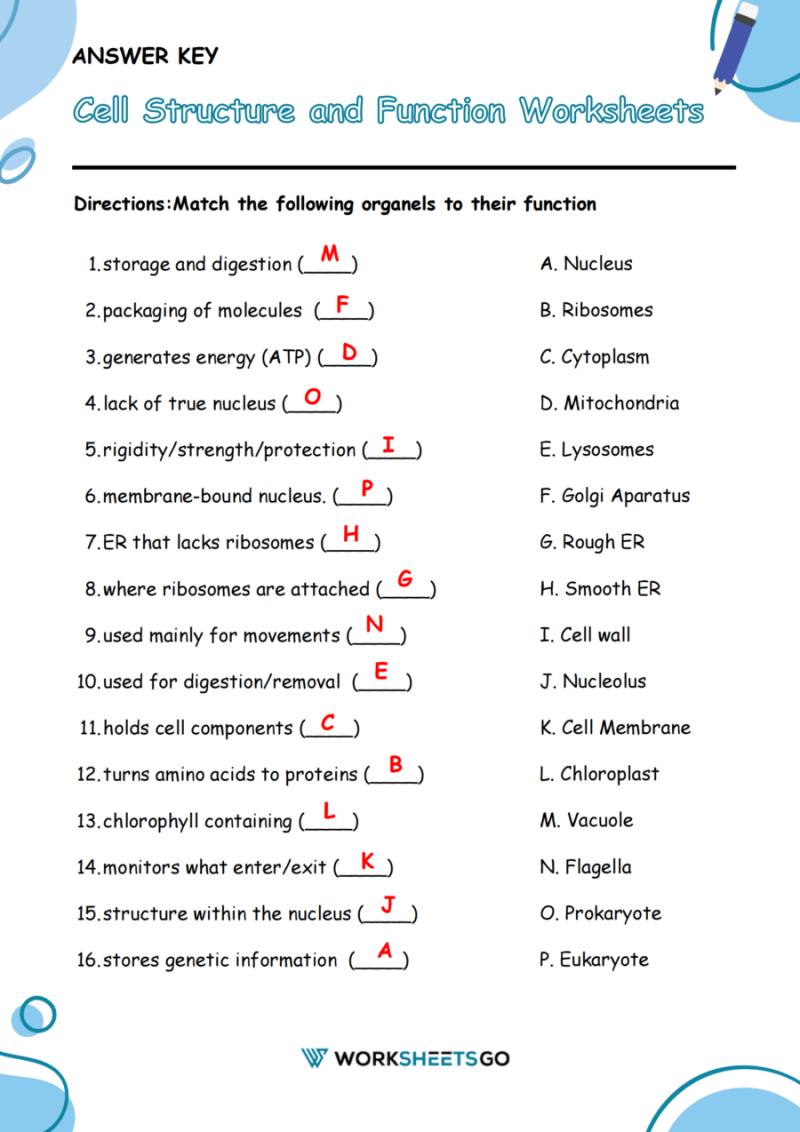
Instructional materials like a cell anatomy worksheet facilitate this understanding by breaking down the "factory model" of the cell. For instance, the nucleus acts as the command center, housing genetic material (DNA), while the ribosomes serve as the manufacturing units for proteins. By categorizing these parts into functional groups—such as energy production, protein synthesis, and waste management—students can grasp the interconnectedness of cellular life rather than viewing organelles as isolated entities.

Key Benefits and Crucial Impact
The implementation of a structured worksheet for cell structure and function offers significant cognitive advantages in a classroom setting. It transforms the learning process from a rote memorization exercise into an analytical investigation. When students are tasked with matching an organelle to its specific function or predicting the outcome of an organelle malfunction, they are engaging in higher-order thinking skills that are essential for scientific literacy.
Furthermore, these tools provide a standardized method for assessing student progress. Educators can quickly identify misconceptions—such as confusing the roles of the smooth and rough endoplasmic reticulum—and provide targeted interventions. The impact extends beyond the classroom, as a solid foundation in cellular biology is the prerequisite for understanding genetics, physiology, and pathology in later stages of scientific study.
"The cell is the fundamental unit of life, and understanding its intricate dance is the first step toward mastering the complexities of all living systems."
Major Advantages
- Enhanced Spatial Recognition: Helps students visualize the three-dimensional arrangement of organelles within a two-dimensional plane.
- Active Recall Integration: Forces students to retrieve information from memory, which is a proven method for strengthening long-term retention.
- Comparative Learning: Encourages the ability to distinguish between plant and animal cells, a cornerstone of biological classification.
- Scaffolded Complexity: Allows instructors to layer difficulty, starting with simple labeling and moving toward complex functional scenarios.
- Standardized Assessment: Provides a clear metric for both students and teachers to gauge mastery of foundational biological concepts.
Comparative Analysis
| Feature | Traditional Lecture | Worksheet-Based Learning |
|---|---|---|
| Student Engagement | Passive listening and note-taking. | Active problem-solving and application. |
| Retention Rate | Lower, due to lack of immediate application. | Higher, through repetitive and meaningful practice. |
| Concept Mastery | General overview of topics. | Granular understanding of specific functions. |
| Assessment Speed | Delayed until formal testing. | Immediate feedback during the learning process. |

Future Trends and Innovations
As we move further into the digital age, the traditional paper-based worksheet for cell structure and function is undergoing a digital transformation. Interactive, augmented reality (AR) worksheets are beginning to emerge, allowing students to point a tablet at a diagram and see a 3D, animated model of a mitochondrion or a lysosome. This immersion provides a level of engagement that static images simply cannot match, making the invisible visible in real-time.
Moreover, the integration of Artificial Intelligence (AI) in educational tools is poised to create hyper-personalized learning paths. Future iterations of cell biology study aids will likely adapt to a student's specific struggle points. If a student consistently fails to understand the role of the Golgi apparatus on their worksheet, the system will automatically adjust the complexity and style of subsequent questions to reinforce that specific concept, ensuring no student is left behind in the study of life's building blocks.
Conclusion
The study of the cell is the study of life itself. Without a clear understanding of how microscopic structures facilitate macroscopic existence, the field of biology remains an impenetrable mystery. Tools such as a worksheet for cell structure and function serve as the essential bridge between curiosity and comprehension, providing the framework necessary for students to navigate the complexities of biological systems.
By prioritizing structured, analytical, and engaging instructional materials, educators can foster a generation of scientists who do not just memorize facts, but understand the profound mechanisms that drive every living organism. As technology continues to evolve, these tools will only become more potent, further illuminating the incredible complexity of the cellular world.
Comprehensive FAQs
Q: Why is it important to distinguish between plant and animal cells in a worksheet?
A: Distinguishing between these two is vital because it highlights the fundamental differences in how organisms obtain energy and maintain structure. For example, identifying the cell wall and chloroplasts in plant cells versus their absence in animal cells helps students understand the principles of photosynthesis and structural support.
Q: Can a worksheet for cell structure and function be used for advanced students?
A: Absolutely. While basic worksheets focus on identification, advanced versions can focus on "what if" scenarios—such as the consequences of a lysosome failing to function or the impact of a mutation in the nuclear DNA—thereby promoting critical thinking and biochemical reasoning.
Q: What are the most common mistakes students make when studying organelles?
A: Students often struggle with the distinction between the different types of endoplasmic reticulum (smooth vs. rough) and the specific roles of the various transport vesicles. A well-designed worksheet addresses these specific pain points through targeted comparison questions.
Q: How does visual learning assist in understanding cellular biology?
A: Because cells are microscopic and cannot be seen with the naked eye, visual aids are the primary way students build a mental model of biological reality. Diagrams and worksheets provide the necessary visual context to connect a name to a physical shape and function.
Q: Is digital learning more effective than paper worksheets for biology?
A: Both have merits. Paper worksheets allow for focused, distraction-free writing and sketching, which aids motor memory. Digital worksheets offer interactivity and immediate feedback. The most effective pedagogical approach often combines both methods to cater to different learning styles.
Leave a Comment
Comments are moderated before appearing. The data you submit is processed according to the Privacy Policy of cixa.org.